
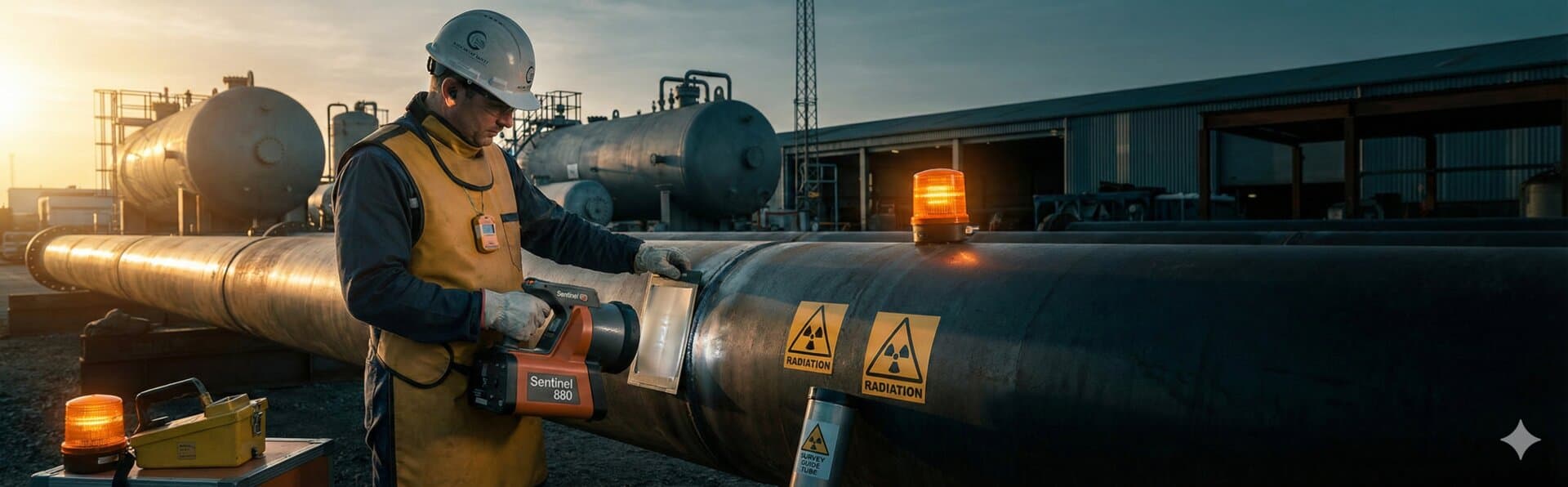
Radiographic Testing (RT)
Internal structural defect detection with X-ray and gamma rays
What is Radiographic Testing?
Radiographic testing is a non-destructive testing method that uses ionizing radiation (X-ray or gamma ray) to detect discontinuities in the internal structure of materials or welded joints.
Basic Principle
1) Radiation is applied to the material with X-ray tube or radioactive isotope (Ir-192, Co-60). 2) Radiation falls on the film or digital detector in the background. 3) If there is a defect in the material (void, slag, crack), more radiation passes through this area. 4) This difference is detected as a contrast difference on the image.
Advantages Over Other NDT Methods
- Volumetric Defect Detection: Clearly shows volume defects such as porosity, slag, lack of penetration.
- Permanent Record: Film or digital image can be archived and provides traceability.
- Visual Interpretation: Operator can examine the defect visually in physical form.
- Geometry Independent: Can be successfully applied to parts with complex geometry.
- Direction Independent Detection: Can be detected regardless of defect orientation.
Detected Defect Types
- Gas Voids (Porosity): Small or large gas-induced voids
- Slag Inclusions: Slag particles trapped in the weld
- Lack of Penetration: Insufficient fusion at the root
- Lack of Fusion: Incomplete bonding between layers
- Solidification Cracks: Cracks especially formed in cast parts
- Foreign Material Inclusions: Tungsten, slag or metal particle entrapment
Note: Since sensitivity to fine surface cracks is low, MT or PT methods should be preferred for such defects.
Technical Details
Radiation Sources
X-Ray Equipment
General purpose inspections
Iridium-192 (Ir-192)
Parts 10-60 mm thick
Cobalt-60 (Co-60)
Parts 50-150 mm thick
Selenium-75 (Se-75)
Parts 5-30 mm thick
Imaging Methods
Conventional Film
Imaging with traditional X-ray film
Industrial Importance
Radiographic testing is frequently preferred in sectors requiring high quality and safety-critical components. It is indispensable especially in certification and customer-approved projects.
Pressure Vessels and Pipes
Volumetric inspection of weld seams (boilers, pipelines, heat exchangers)
Petrochemical / Refinery
Tanks, valves, flange weld inspection
Nuclear Energy
Reactor sections, high-risk joints
Aerospace
Critical cast parts, landing gear components
Casting Industry
Detection of porosity and mold defects in castings
Defense and Shipyards
Military equipment, armor panels, submarine welds
Radiation Safety
Radiographic testing requires special safety precautions as it involves ionizing radiation. All our work is performed under TAEK (Turkish Atomic Energy Authority) license by our expert and certified personnel.
Standards and Certifications
Other NDT Methods
Get RT Inspection Service
Contact us for your radiographic testing needs with our TAEK licensed expert team.
Get a Quote