
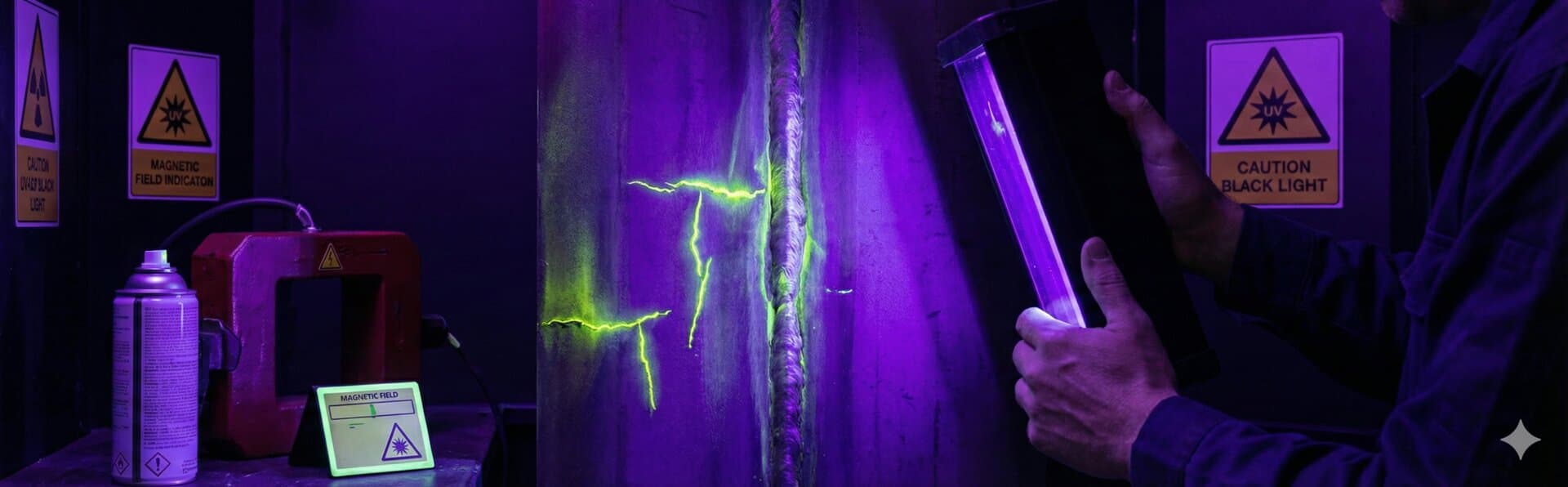
Magnetic Particle Testing (MT)
Surface defect detection in ferromagnetic materials
What is Magnetic Particle Testing?
Magnetic Particle Testing is a non-destructive testing method used to detect discontinuities on the surface and in very near subsurface layers (1-3 mm) in ferromagnetic materials (iron, nickel, cobalt and their alloys).
Basic Principle
The part to be inspected is magnetized (with DC, AC or half-wave AC). If there is a discontinuity (crack, etc.) in the material, the magnetic field passage is disrupted and flux leakage occurs. Magnetic particles (dry powder or wet suspension) applied to this area collect around the leakage field, forming a visual indication.
Advantages Over Other NDT Methods
- High Sensitivity: Very sensitive for surface and near-surface defects, especially surface cracks.
- Fast and Practical: Results can be obtained quickly in the field.
- Visual Result: Defect location can be seen directly with the eye thanks to particles.
- Cost-Effective: Equipment and consumables are relatively inexpensive.
- Complex Geometry: Suitable for welded joints, gear surfaces, cast parts.
Detected Defect Types
- Surface Cracks: Most sensitively detected defect type, especially fatigue cracks.
- Surface Weld Defects: Lack of fusion and cracks visible on the surface.
- Solidification Cracks: Surface cracks formed in cast parts.
- Grinding Cracks: Surface micro-cracks caused by thermal stresses.
- Surface Voids: Surface-breaking porosity and inclusions.
- Rolling Cracks: Surface cracks seen in rolled products.
Note: Only surface and near-surface discontinuities at 1-3 mm depth can be detected.
Technical Details
Magnetization Methods
Yoke Method
Local magnetization with electromagnetic yoke
Prod Method
Direct current passage through electrodes
Coil Method
Circumferential magnetization of cylindrical parts
Permanent Magnet
Application with portable permanent magnets
Particles and Imaging
Dry Powder Method
Ideal for surface defects with AC current
Wet Suspension
For near-surface defects with DC/half-wave AC
Visible Particles
Black/colored particles under normal light
Fluorescent Particles
Higher sensitivity under UV light
Material Limitation
Magnetic particle testing can only be applied to ferromagnetic materials (iron, nickel, cobalt and their alloys). For materials such as austenitic stainless steel, aluminum and copper, Penetrant Testing (PT) should be preferred.
Industrial Importance
Magnetic particle testing is critically important especially in parts and joints containing ferromagnetic materials.
Welded Manufacturing Sector
Post-weld surface crack inspection (cranes, bridges, pressure vessels)
Railway and Automotive
Axle, wheel, suspension parts inspection
Aerospace and Defense
Rotor shafts, gear systems inspection
Energy and Nuclear
Turbine parts, flanges, pipeline welds
Casting and Metal Processing
Surface crack and mold defect inspection in steel castings
Standards and Certifications
Other NDT Methods
Get MT Inspection Service
Contact us for your magnetic particle testing needs with our expert team.
Get a Quote