
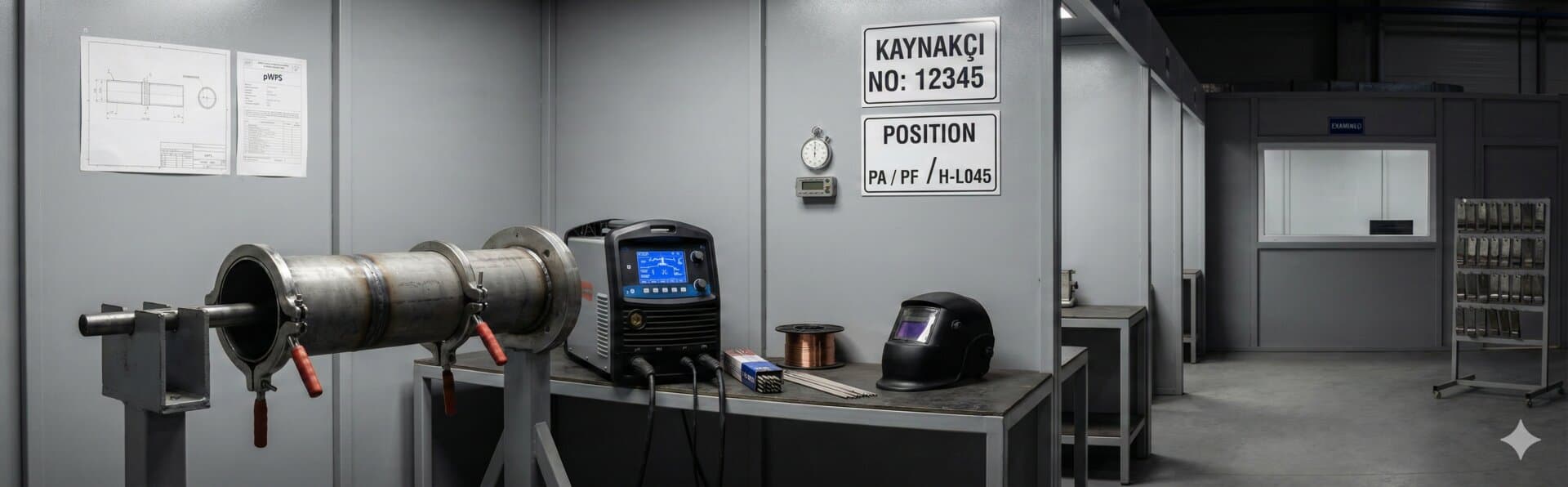
Welder Certification
Professional welding personnel certification and authorization
What is Welder Certification?
Welder certification is the documentation of welders' competencies after passing theoretical and practical exams according to relevant standards, and evaluating test pieces through non-destructive (NDT) and destructive tests. This certification guarantees that welders can perform quality work in accordance with specific welding procedures.
Certification Process
1) Welder candidate welds test piece according to specified standard. 2) Test piece is inspected by RT (Radiographic), UT (Ultrasonic) or other NDT methods. 3) Destructive tests such as bend and tensile are applied if required. 4) Certificate is issued to welders meeting standard acceptance criteria.
Importance of Welder Certification
- Quality Assurance: Certified welder works according to standard procedures.
- Customer and Institutional Requirements: Most projects or tenders require certified welding personnel.
- Reduced Error Risk: Trained and tested welders make fewer faulty welds.
- Traceability: Records of work done by each welder can be kept with their certificate.
- International Validity: Certificates issued according to ISO standards are recognized worldwide.
Certification Scope
- Welding Method: MAG, MIG, TIG, Electrode, SAW etc.
- Base Material Group: Steel, aluminum, stainless, nickel alloys
- Product Type: Pipe, plate, profile, casting
- Welding Position: PA (flat), PF (horizontal), PG (vertical up), PH (overhead), etc.
- Thickness and Diameter Range: Specific ranges are valid according to test piece thickness.
- Filler Metal: Solid wire, flux cored wire, electrode type
Note: Each certificate is valid for a specific combination of welding method, material group and position. Separate certificates may be required for different scopes.
Certification Standards
| Standard | Description | Scope |
|---|---|---|
TS EN ISO 9606-1 | Welder Certification for Fusion Welding of Steels | Carbon, low alloy and high strength steels |
TS EN ISO 9606-2 | Welder Certification for Welding of Aluminum and Alloys | Aluminum and aluminum alloys |
TS EN ISO 14732 | Welding Operators and Welding Setters Certification for Fully Mechanized and Automatic Fusion Welding | Automatic/robot welding operators, fully mechanized welding systems |
ASME SEC IX | Pressure Vessel Welder and Welding Operator Certification with ANSI/ASME SEC IX Verification Method | Pressure equipment, boilers, reactors requiring ASME Code |
API 1104 | Pipeline Welder Certification with API 1104 Verification Method | Oil and gas pipelines, steel pipes |
Accreditation and Approval
All our welder certification activities are carried out within the scope of relevant accreditation bodies and/or customer approved procedures. Our certificates have international validity and are subject to regular surveillance audits.
Our Service Scope
1Test Piece Preparation
- Test specimen design according to standard
- Material procurement and preparation
- Welding procedure (WPS) application
- Examination environment setup
2Practical Exam Management
- Welder candidate performing welding
- Supervision of exam process
- Inspection of procedure compliance
- Marking and recording of test piece
3Non-Destructive Testing (NDT)
- RT (Radiographic) inspection
- UT (Ultrasonic) inspection
- VT (Visual) inspection
- MT/PT (Magnetic/Penetrant) inspection
4Destructive Testing
- Bend test
- Tensile test
- Impact test (when required)
- Macroscopic and microscopic examination
5Evaluation and Reporting
- Evaluation of test results according to standard
- Compliance check with acceptance criteria
- Preparation of detailed exam report
- Documentation of defects/rejections
6Certificate Issuance
- Issuing certificates to successful candidates
- Determining certificate scope ranges
- Certificate validity period information
- Digital and physical certificate delivery
Which Sectors Require Welder Certification?
There is a requirement to employ certified welders in quality and safety critical industries.
Pressure Vessel and Pipe Manufacturing
Mandatory for boiler, tank, reactor, pipeline welds
Oil and Gas Pipelines
API 1104 standard requires certified welder
Aerospace Industry
Special certification for critical structural components
Shipbuilding and Shipyards
For ship hull, tank and pipe system welds
Nuclear Power Plants
Mandatory certification in ASME Code applications
Refinery and Petrochemical
Required for high pressure and temperature systems
Steel Construction (EN 1090)
Certified welding personnel required for CE marking
Railway Vehicles
Certification requirement for wagon, locomotive manufacturing
Certificate Validity Period and Renewal
Welder certificates are generally valid for 2 or 3 years (varies by standard). Renewal may require new examination or record check at the end of the period. Additionally, documentation that the welder is actively using the relevant welding method (welding records) is mandatory.
Related Certification Services
Certify Your Welders
Contact us for our welder certification service compliant with ISO and ASME standards. Fill out our form to get detailed information and a quote.
Apply Now